
You're eating well, exercising regularly, sleeping adequately — and still gaining weight around your midsection. One of the most overlooked culprits is also one of the most common: chronically elevated cortisol from ongoing stress.
→ Already decided? view the 2026 Citrus Burn verdict →
Cortisol's role in weight gain goes far beyond "stress eating." It fundamentally alters how your body stores fat, what fuel it burns, how hungry you feel, and how effectively your metabolic systems function. Understanding the cortisol-weight connection is often the missing piece for people who are "doing everything right" and still struggling.
What Is Cortisol and Why Does It Exist?
Cortisol is a glucocorticoid hormone produced by the adrenal glands, primarily in response to stress. In acute, short-term situations, cortisol serves critical survival functions:
Reader Feedback
"Love how the information is laid out here — not sensationalized, not overly promotional. Just straight facts with context. Will be checking back for more reviews."
"Came across this through a Google search and it answered the exact question I had. The FAQ section at the bottom was particularly helpful. Solid resource."
- Rapidly mobilizes glucose from liver glycogen for immediate energy
- Suppresses non-essential functions (digestion, reproduction, immune response) to prioritize survival
- Increases heart rate and blood pressure for physical response to threat
- Sharpens focus and mental clarity temporarily
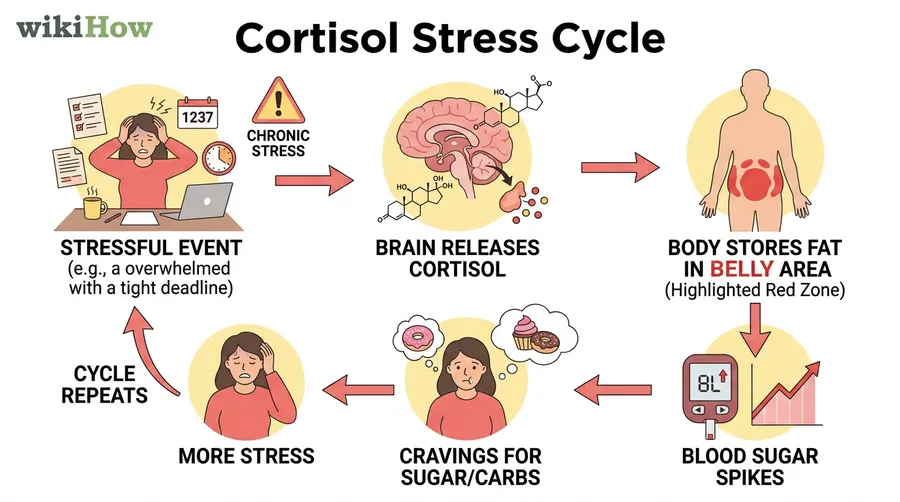
These effects are adaptive when stress is brief and physical. The problem is that modern human stress — financial pressure, work deadlines, relationship conflict, traffic, sleep deprivation, digital overload — is chronic and psychological rather than brief and physical. The body's cortisol response is identical in both cases, but the physical discharge (running from a predator) that would normally metabolize the cortisol-driven glucose never happens.
Want the full picture? our complete Citrus Burn breakdown before deciding.
How Chronic Cortisol Causes Weight Gain
Mechanism 1: Visceral Fat Accumulation
Visceral fat cells — the fat deposited around organs in the abdominal area — contain a significantly higher density of cortisol receptors than subcutaneous fat cells (the fat under the skin). This means visceral fat cells are exquisitely sensitive to cortisol and respond to elevated cortisol by dramatically upregulating fat storage.
Research at Yale University, led by Dr. Pamela Peeke, found that women with high cortisol levels had significantly greater visceral fat accumulation than low-cortisol women of the same total body weight and diet. Visceral fat is metabolically active in harmful ways: it secretes inflammatory cytokines, impairs insulin signaling, and is a major driver of metabolic syndrome.
Mechanism 2: Elevated Blood Sugar and Insulin Resistance
Cortisol causes the liver to release glucose into the bloodstream (gluconeogenesis) while simultaneously reducing insulin sensitivity in muscle cells. The result: elevated blood glucose that the body cannot efficiently use for energy, triggering insulin release and — when this persists chronically — insulin resistance. Insulin resistance is one of the most powerful drivers of weight gain and fat storage, independent of caloric intake.
Research published in Diabetes Care found that chronic psychological stress produces equivalent blood sugar dysregulation as consuming 25% more calories — demonstrating that the metabolic impact of cortisol operates largely independently of what you eat.
Mechanism 3: Increased Appetite and Food Cravings
Cortisol directly stimulates appetite by increasing the production of neuropeptide Y — a potent appetite stimulant — while simultaneously making the brain's reward centers hypersensitive to high-calorie foods. Research from the Journal of Clinical Endocrinology & Metabolism found that cortisol infusion increased caloric intake by 29% in healthy adults, with the increased intake specifically directed toward sweets and high-fat foods.
This explains the well-documented phenomenon of "stress eating" — it's not purely psychological. The foods craved during stress (chocolate, chips, ice cream) are neurologically rewarding in ways that temporarily suppress cortisol signaling, creating a feedback loop where stress → cortisol → craving for comfort foods → temporary relief → guilt → more stress.
Mechanism 4: Impaired Muscle Building and Fat Burning
Cortisol is catabolic — it breaks down tissue for energy. Chronically elevated cortisol suppresses testosterone and growth hormone (both anabolic — muscle-building — hormones), inhibits muscle protein synthesis, and promotes the breakdown of muscle protein into glucose. The result is a progressive shift in body composition toward less muscle (lower metabolic rate) and more fat.
Research published in Psychoneuroendocrinology found that chronically stressed individuals showed significantly lower muscle protein synthesis rates than low-stress controls even when protein intake and exercise were matched — demonstrating that cortisol itself, independent of behavior, impairs the body's ability to build and maintain metabolically active muscle tissue.
Mechanism 5: Sleep Disruption
Cortisol and sleep are in direct opposition: cortisol is meant to be high in the morning (to facilitate waking) and low at night (to facilitate sleep onset). Chronic stress disrupts this rhythm — elevating evening cortisol and making it difficult to fall and stay asleep. As covered in our article on how sleep affects weight loss, sleep deprivation then generates its own metabolic cascade of hunger hormones and impaired fat burning — creating a vicious cycle.
Signs of Chronically Elevated Cortisol
- Accumulation of abdominal fat despite overall healthy weight
- Difficulty falling or staying asleep despite feeling exhausted
- Afternoon energy crashes with intense sugar cravings
- Anxiety, irritability, or feeling "wired but tired"
- Getting sick frequently (cortisol suppresses immune function)
- Acne or skin problems (cortisol triggers inflammatory pathways)
- Difficulty recovering from exercise; excessive muscle soreness
- Brain fog, poor memory, difficulty concentrating

How to Lower Cortisol and Break the Cycle
Prioritize Sleep (Non-Negotiable)
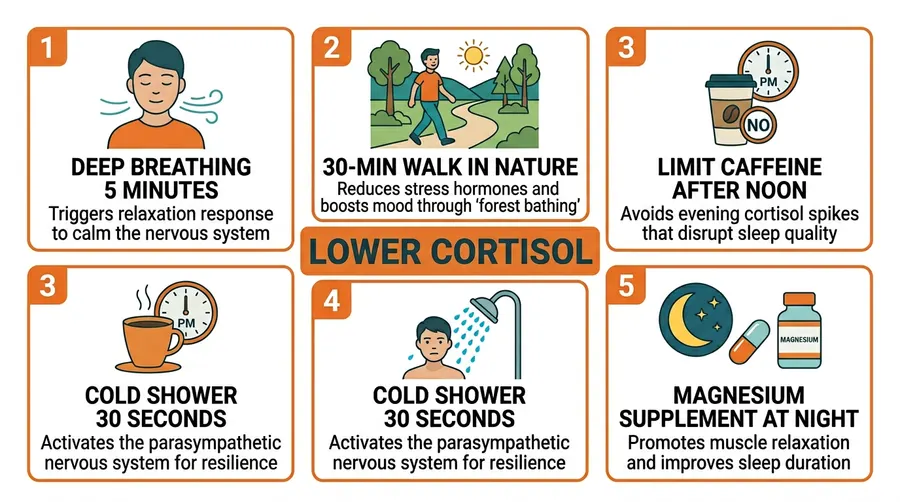
Normalizing the cortisol circadian rhythm requires consistent, quality sleep. Research consistently shows that 7–9 hours of quality sleep is the most powerful cortisol-normalizing intervention. Morning light exposure (10–30 minutes within the first hour of waking) strengthens the cortisol awakening response and helps normalize the evening decline.
Practice Daily Stress Reduction
Mindfulness meditation, practiced consistently, produces measurable reductions in cortisol. A meta-analysis in Health Psychology Review analyzing 45 studies found mindfulness meditation reduced cortisol levels by 16% on average. The key word is "consistently" — a daily 10-minute practice produces larger effects than occasional longer sessions. Yoga, nature walks, breathwork (particularly extended exhales, which activate the parasympathetic nervous system), and even social connection have robust evidence for cortisol reduction.
Exercise — But Don't Overtrain
Moderate exercise is one of the most effective cortisol regulators, both normalizing the cortisol rhythm and improving HPA axis sensitivity over time. However, excessive high-intensity training without adequate recovery raises cortisol chronically. The sweet spot for metabolic health: 3–4 sessions per week of moderate-to-vigorous exercise, with at least one rest day between intense sessions and 7–8 hours of sleep.
Anti-Cortisol Nutrition
Vitamin C: The adrenal glands have the highest concentration of vitamin C of any organ — it's depleted by cortisol production. Research shows 1,000mg vitamin C daily reduces both cortisol and subjective stress scores.
Phosphatidylserine: A phospholipid that blunts the cortisol response to exercise and psychological stress, studied at doses of 400–800mg daily.
Ashwagandha (KSM-66 extract): An adaptogenic herb with the strongest clinical evidence in the category. A double-blind study in the Journal of the American Nutraceutical Association found 300mg twice daily reduced cortisol by 27% and self-reported stress by 44% over 60 days.
Magnesium: Chronically elevated cortisol depletes magnesium, and magnesium deficiency worsens cortisol response — a vicious cycle. Magnesium glycinate (400–600mg daily) addresses both the deficiency and the cortisol dysregulation.
Time-Restricted Eating Can Help
Aligning your eating window with daylight hours (finishing the last meal by 7–8pm) supports circadian cortisol regulation. Evening eating — particularly high-sugar foods — elevates cortisol and insulin simultaneously, worsening overnight metabolic recovery and disrupting the cortisol nadir needed for quality sleep.
📋 Want our complete analysis?
the full Citrus Burn deep-dive →"Sharing this with my wellness group. Great breakdown that doesn't try to oversell anything — just explains how things work. Exactly what the internet needs more of."
The Bottom Line
Chronic stress and cortisol dysregulation can make weight management frustratingly difficult regardless of diet and exercise efforts. Addressing cortisol is not "soft" — it's physiologically necessary. For many adults over 40, stress and sleep management are the primary metabolic leverage points that diet and exercise alone cannot overcome. Read our deep-dive on how poor sleep wrecks your weight loss for the full hormonal picture.
Men should note that chronically elevated cortisol directly suppresses testosterone — one reason prostate and hormonal health supplements like ProstaVive include cortisol-modulating adaptogens such as ashwagandha. Implementing sleep optimization, daily stress management practices, appropriate exercise frequency, and targeted nutritional support for cortisol regulation can transform metabolic outcomes for people who have been stuck despite doing "everything else right."