
After 40, the diet that kept you lean in your 30s suddenly stops working. Workouts feel harder, the scale creeps upward, and energy dips in the afternoon. You're not imagining it.
Research published in the Journal of Clinical Endocrinology & Metabolism confirms that resting metabolic rate declines approximately 1–2% per decade after age 40, with the rate accelerating after 60. For a 45-year-old woman, this means burning 200–300 fewer calories per day than she did at 25 — equivalent to gaining one pound of fat every two to three weeks without changing a single habit.
But metabolic decline is not inevitable. Groundbreaking research now shows that the primary drivers are largely controllable. Here are 12 evidence-based strategies that actually work.
Why Metabolism Slows After 40: The Three Root Causes
1. Sarcopenia (Age-Related Muscle Loss)
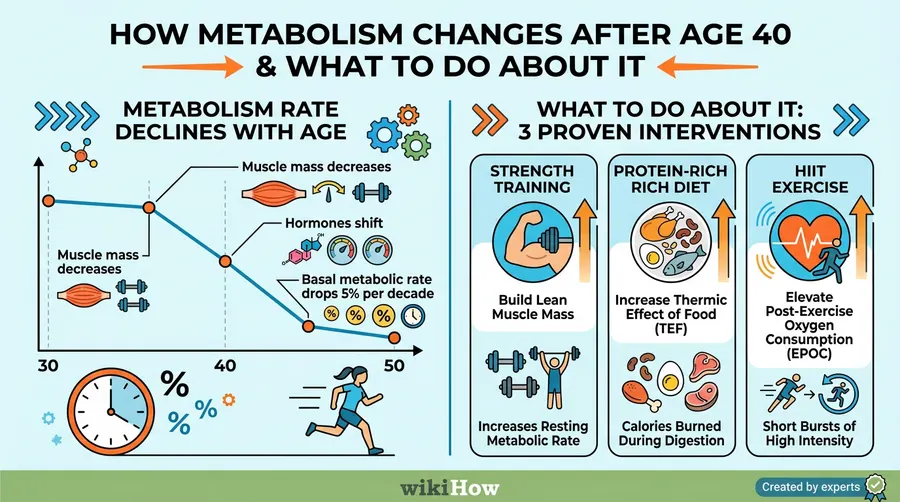
Adults lose 3–8% of muscle mass per decade without intervention, a process called sarcopenia. Since muscle tissue burns approximately 6–10 calories per pound per day at rest — three times more than fat — losing even 5 lbs of muscle reduces your resting metabolic rate by 30–50 calories daily. Over a year, that's 3–5 lbs of fat gain with no change in diet.
Reader Feedback
"This article gave me more actionable info than 6 months of scrolling TikTok. The part about cortisol and stress eating finally explained why my diet kept failing. Sharing with my sister."
"40 and metabolically confused is my new life description. This article actually makes sense of it — thank you. Bookmarked and sharing with my trainer."
2. Hormonal Shifts
Declining estrogen, testosterone, and growth hormone after 40 fundamentally alter fat metabolism. Research from the American Journal of Physiology shows these hormonal changes increase visceral fat storage (around organs) while reducing the body's capacity for fat oxidation by up to 30%.
3. Reduced NEAT (Non-Exercise Activity Thermogenesis)
NEAT — calories burned through everyday movement like walking, fidgeting, and standing — accounts for 15–30% of total daily energy expenditure. Studies published in Science found that NEAT declines significantly with age and can vary by up to 2,000 calories between individuals. Even small reductions in spontaneous movement compound dramatically over time.

12 Strategies to Rebuild Your Metabolism
1. Make Strength Training Non-Negotiable
A meta-analysis in the British Journal of Sports Medicine reviewing 49 studies found that resistance training 2–3 times per week increases resting metabolic rate by 7–8% and directly reverses sarcopenia. This is the single most impactful metabolic intervention available — no pill or supplement comes close. Focus on compound movements: squats, deadlifts, rows, and presses. Progressive overload (gradually increasing weight) is the key stimulus.
2. Increase Protein Intake Significantly
Protein has the highest thermic effect of any macronutrient — your body burns 20–30% of protein calories just to digest and metabolize it, compared to 5–10% for carbohydrates and 0–3% for fat. Research in the American Journal of Clinical Nutrition shows that high-protein diets (1.2–1.6g per kg of bodyweight daily) significantly increase metabolic rate while preserving muscle mass during weight loss. For a 150-lb person, this means roughly 80–110g of protein daily.
3. Add HIIT to Your Routine
High-Intensity Interval Training creates an "afterburn effect" (excess post-exercise oxygen consumption, or EPOC) that keeps metabolism elevated for 12–24 hours post-workout. A landmark 2017 study in Cell Metabolism found that HIIT actually reverses cellular aging markers and improves mitochondrial function even in adults over 65 — something moderate cardio cannot achieve. Just 20 minutes, 2–3 times per week, is sufficient.
4. Optimize Sleep (Most Underestimated Factor)
A study in the Annals of Internal Medicine found that cutting sleep from 8.5 to 5.5 hours for two weeks reduced fat burned during weight loss by 55% while simultaneously increasing hunger hormones by 20–30%. Poor sleep elevates cortisol, impairs insulin sensitivity, and suppresses growth hormone — three metabolic disasters that compound quickly. Prioritize 7–9 hours and keep a consistent sleep schedule.
5. Never Underestimate Hydration
Research in the Journal of Clinical Endocrinology & Metabolism found that drinking 500ml of water increases metabolic rate by 30% for 30–40 minutes. This "water-induced thermogenesis" is driven partly by the energy required to heat the water to body temperature. Even mild dehydration (1–2% body weight) measurably reduces metabolism and impairs fat oxidation.
6. Drink Green Tea Daily
Green tea's combination of caffeine and EGCG (epigallocatechin gallate) works synergistically to increase fat oxidation. A systematic review in the International Journal of Obesity analyzing 11 trials found green tea catechins increased 24-hour energy expenditure by 4–5% and fat oxidation by up to 17% — particularly effective for abdominal fat in people over 35.
7. Add Capsaicin to Your Diet
Capsaicin — the active compound in chili peppers — activates the TRPV1 receptor, triggering thermogenesis and increasing fat oxidation. A meta-analysis in PLOS ONE found capsaicin supplementation increases energy expenditure by approximately 50 calories per day and specifically reduces visceral (belly) fat. Even a daily dose of hot sauce delivers measurable benefits.
8. Actively Manage Stress and Cortisol
Chronic stress elevates cortisol, which directly impairs fat metabolism and promotes fat storage — especially visceral fat. Research from Yale University found that high cortisol was strongly associated with both increased caloric intake and abdominal fat accumulation independent of diet. Even 10 minutes of mindful breathing daily measurably reduces cortisol levels within four weeks.
9. Try Brief Cold Exposure
Research in the New England Journal of Medicine confirmed that humans possess brown adipose tissue (brown fat) that burns calories to generate heat. Cold exposure activates brown fat, increasing metabolic rate by 10–15% in some individuals. Ending showers with 30–60 seconds of cold water is a low-barrier daily practice with meaningful cumulative effects.
10. Eat a High-Protein Breakfast
Studies from the American Journal of Clinical Nutrition show that eating 30+ grams of protein at breakfast reduces total daily calorie intake and maintains a stable metabolic rate throughout the day. Skipping breakfast, particularly after 40, is associated with muscle catabolism (breakdown) and reduced thermogenesis.
11. Avoid Prolonged Calorie Restriction
Crash dieting is metabolically catastrophic. Research in Obesity Reviews found that very low-calorie diets reduce metabolic rate by up to 23% — and this reduction can persist for years after the diet ends. This "adaptive thermogenesis" is why yo-yo dieting becomes progressively harder. Aim for a modest deficit of 300–500 calories maximum, with periodic "diet breaks" at maintenance calories.
12. Consider Evidence-Based Metabolic Support
Certain supplements have meaningful scientific backing for metabolic enhancement. Berberine activates AMPK — an enzyme that regulates metabolism similarly to exercise. Green tea extract, capsaicin, and compounds targeting thermogenic pathways have demonstrated consistent effects in clinical research. For adults over 35 dealing with significant metabolic resistance, comprehensive formulas that address these mechanisms may provide additional support. Not sure if your metabolism is actually slow? Read our 12 warning signs of a slow metabolism. Our expert comparison of leading metabolic supplements covers the evidence in detail.
The Most Powerful Combination
Research consistently shows that combining strategies 1 (strength training) + 2 (high protein) + 3 (HIIT) + 4 (sleep optimization) produces synergistic effects greater than any single strategy alone. Implement these four first, then layer in the remaining strategies over 8–12 weeks. The result is a genuinely rebuilt metabolic baseline — not a temporary fix.
"The thermogenesis section was genuinely eye-opening. I always thought 'metabolism boost' was marketing fluff. The actual science is more interesting. Great breakdown."
Key Takeaways
- Metabolic decline after 40 is primarily driven by muscle loss, hormonal changes, and reduced movement — all of which are addressable
- Strength training is the single most powerful metabolic intervention — it directly reverses the root cause (sarcopenia)
- High-protein diets have a significant thermic advantage and protect muscle during weight loss
- Sleep, hydration, and stress management have larger metabolic impacts than most people realize
- Combining multiple strategies produces synergistic results that no single approach can match