
When most people think about burning fat, they think about exercise. But some of the most significant fat burning that occurs in your body happens at rest — through a process called thermogenesis.
Thermogenesis literally means "heat creation." Your body constantly produces heat as a byproduct of metabolism, and this heat production requires burning calories — primarily from fat. Understanding thermogenesis and how to enhance it is one of the most underutilized tools in weight management.
The Three Types of Thermogenesis
1. Basal Metabolic Thermogenesis
Your Basal Metabolic Rate (BMR) — the calories burned at complete rest — accounts for 60–70% of total daily energy expenditure. Most of these calories are burned to maintain body temperature at 98.6°F (37°C). Virtually every biochemical process in your body generates heat: protein synthesis, ion pumping across cell membranes, and the constant recycling of ATP.
Reader Feedback
"The thermogenesis section was genuinely eye-opening. I always thought 'metabolism boost' was marketing fluff. The actual science is more interesting. Great breakdown."
"This article gave me more actionable info than 6 months of scrolling TikTok. The part about cortisol and stress eating finally explained why my diet kept failing. Sharing with my sister."
Research published in the American Journal of Clinical Nutrition shows that BMR can vary by 200–400 calories per day between individuals of the same size and age — largely due to differences in muscle mass, thyroid function, and mitochondrial efficiency.
2. Exercise-Associated Thermogenesis (EAT)
Physical activity raises body temperature and increases heat production significantly. But the thermogenic effect of exercise extends well beyond the workout itself. High-intensity exercise triggers EPOC (Excess Post-Exercise Oxygen Consumption) — commonly called the "afterburn effect" — where metabolism remains elevated for 12–24 hours as the body repairs muscle tissue and restores metabolic homeostasis. Research shows HIIT can elevate post-exercise metabolism by 6–15%.
3. Diet-Induced Thermogenesis (DIT)
Every time you eat, your body expends energy to digest, absorb, and store nutrients — a process called the thermic effect of food (TEF). Not all macronutrients are equal:
- Protein: 20–30% of calories burned in digestion (highest of any macronutrient)
- Carbohydrates: 5–10% of calories burned in digestion
- Fat: 0–3% of calories burned in digestion (lowest)
A high-protein diet therefore has a meaningful thermogenic advantage: if you eat 2,000 calories per day with 30% from protein (600 calories), you burn approximately 120–180 extra calories daily just through digestion — equivalent to 20–30 minutes of moderate walking.
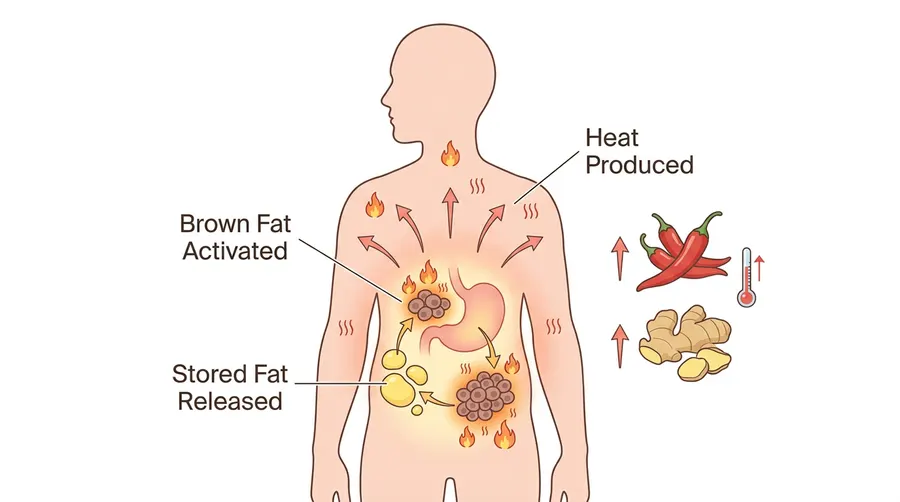
Brown Fat: Your Body's Built-In Thermogenic Furnace
For decades, scientists believed adults had virtually no brown adipose tissue (BAT, or "brown fat") — unlike infants, who use it to stay warm. Then a 2009 study published in the New England Journal of Medicine confirmed that active brown fat depots exist in adult humans, particularly around the neck, upper back, and kidneys.
Brown fat is uniquely thermogenic because it's packed with mitochondria containing a protein called UCP1 (uncoupling protein 1). UCP1 "uncouples" the mitochondrial energy production process — instead of producing ATP, it dissipates energy directly as heat. A single gram of activated brown fat can burn up to 300 times more energy than white fat.
Adults with higher brown fat activity consistently show lower body mass index, better insulin sensitivity, and reduced visceral fat accumulation. Importantly, brown fat can be activated and its activity increased through specific interventions.
Thermogenic Resistance: Why Fat Burning Slows After 35
For many adults, the primary metabolic problem is not how many calories they consume — it's that thermogenic pathways become less responsive over time. This is sometimes called "thermogenic resistance," and it involves:
- Reduced UCP1 expression in brown fat and beige fat cells
- Declining sympathetic nervous system response to food and cold
- Lower mitochondrial density in metabolically active tissues
- Decreased sensitivity to appetite-suppressing hormones (leptin resistance)
Research from the International Journal of Obesity found that adults over 35 show significantly reduced thermogenic response to cold exposure, meals, and adrenergic stimulation compared to younger adults — even with similar body composition. This blunted thermogenic response can account for 100–200 fewer calories burned per day.
How to Enhance Thermogenesis Naturally
Food and Nutrition Strategies
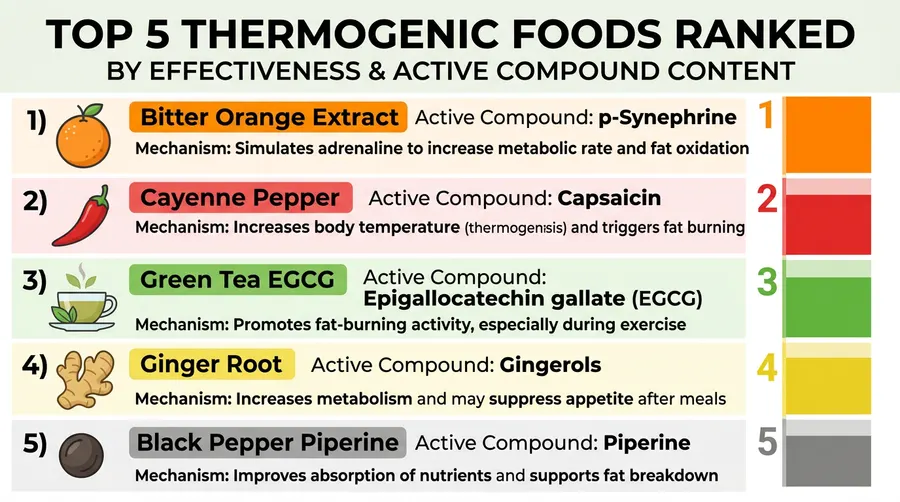
Capsaicin (Chili Peppers): Capsaicin activates TRPV1 receptors, triggering sympathetic nervous system activation and increasing thermogenesis. Clinical studies show regular capsaicin consumption increases energy expenditure by 50–100 calories per day. Research in the Journal of Nutritional Biochemistry also shows capsaicin promotes the "browning" of white fat cells — converting them into more thermogenically active tissue.
Green Tea (EGCG + Caffeine): The catechin EGCG inhibits the enzyme that breaks down norepinephrine — a key thermogenic hormone. This prolongs norepinephrine's activity, extending the thermogenic signal. Combined with caffeine, EGCG increases fat oxidation by 17% during moderate exercise according to a meta-analysis in the International Journal of Obesity.
Protein-Rich Meals: As noted above, protein's 20–30% thermic effect is a consistent thermogenic advantage. Eating 30+ grams of protein per meal maximizes this effect while also preserving muscle mass — the engine of basal thermogenesis.
Ginger: Research published in Metabolism: Clinical and Experimental found that consuming 2g of ginger powder in hot water significantly increased thermogenesis and satiety in overweight men — effects attributed to gingerol's activation of thermogenic pathways similar to capsaicin.
Lifestyle Strategies
Cold Exposure: Cold activates brown fat through the sympathetic nervous system. Regular cold showers (ending with 30–60 seconds of cold water) or cold water immersion (10–15°C for 10–20 minutes) significantly increases brown fat activity over 4–6 weeks. Research published in the Journal of Clinical Investigation found that regular cold exposure increases energy expenditure by 200–300 calories per day in individuals with high brown fat activity.
HIIT Exercise: High-intensity intervals not only create EPOC but have been shown to increase brown fat volume and UCP1 expression in both animal and human studies. The combination of EPOC and enhanced brown fat activity makes HIIT the most thermogenically powerful form of exercise.
Adequate Sleep: Sleep deprivation suppresses UCP1 expression and reduces thermogenic capacity. Research in Obesity found that poor sleep reduces the thermogenic response to meals by up to 20% — meaning the same food produces less heat and fewer calories burned.

Thermogenic Supplements: What the Evidence Says
Several compounds have clinical evidence for thermogenic enhancement beyond their food sources:
- Synephrine (from bitter orange/Seville orange): Research in the International Journal of Medical Sciences shows p-synephrine increases metabolic rate and fat oxidation without meaningfully affecting heart rate or blood pressure — unlike its predecessor ephedrine
- Berberine: Activates AMPK and has been shown to increase thermogenic gene expression in brown fat
- Korean Ginseng: Contains ginsenosides that activate thermogenic pathways and support mitochondrial function
Citrus Burn is a supplement formulated specifically around thermogenic resistance in adults over 35, combining synephrine, capsaicin, EGCG, berberine, and ginseng. Our independent review of Citrus Burn vs Mitolyn compares thermogenic and mitochondrial approaches to metabolic support.
"40 and metabolically confused is my new life description. This article actually makes sense of it — thank you. Bookmarked and sharing with my trainer."
Key Takeaways
- Thermogenesis — your body's heat production — accounts for a significant portion of daily calorie burning, mostly at rest
- Brown fat is a specialized thermogenic tissue found in adults that can be activated and enhanced
- Protein, capsaicin, green tea, and ginger are among the best food-based thermogenic enhancers
- Cold exposure is one of the most powerful activators of brown fat thermogenesis
- Adults over 35 frequently develop thermogenic resistance — if you are in this group, see our guide on boosting metabolism after 40. — reduced responsiveness of fat-burning pathways — that explains why weight management becomes harder with age